# \[View] Tab

#### View Tab Options

The **\[View]** tab provides various options for customizing the map's display and visibility:

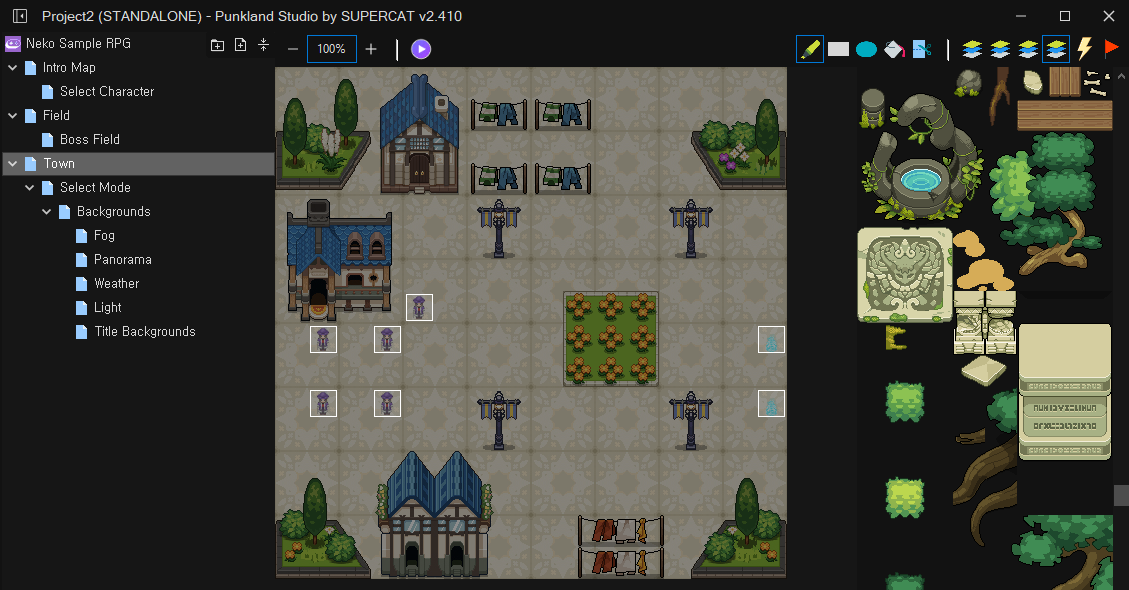
1. **\[Show Current and Sub-Layers]**: Displays the current layer and its sub-layers.
2. **\[Show All Layers]**: Displays all layers simultaneously.
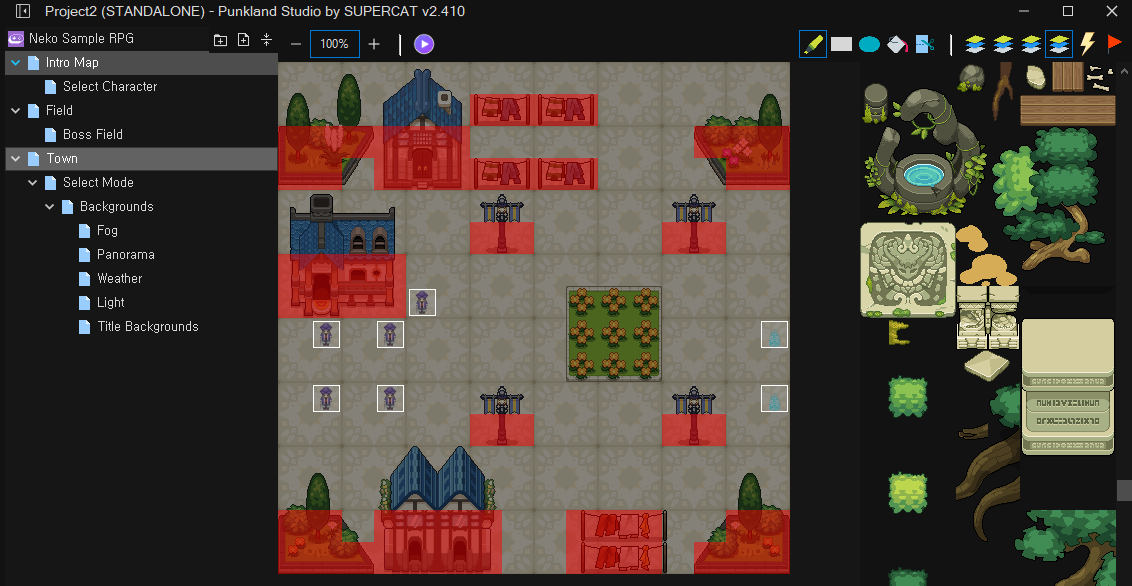
3. **\[Dim Non-Current Layers]**: Dims layers that are not currently selected for editing.
4. **\[Show Collision Areas]**: Highlights areas marked as impassable or restricted.
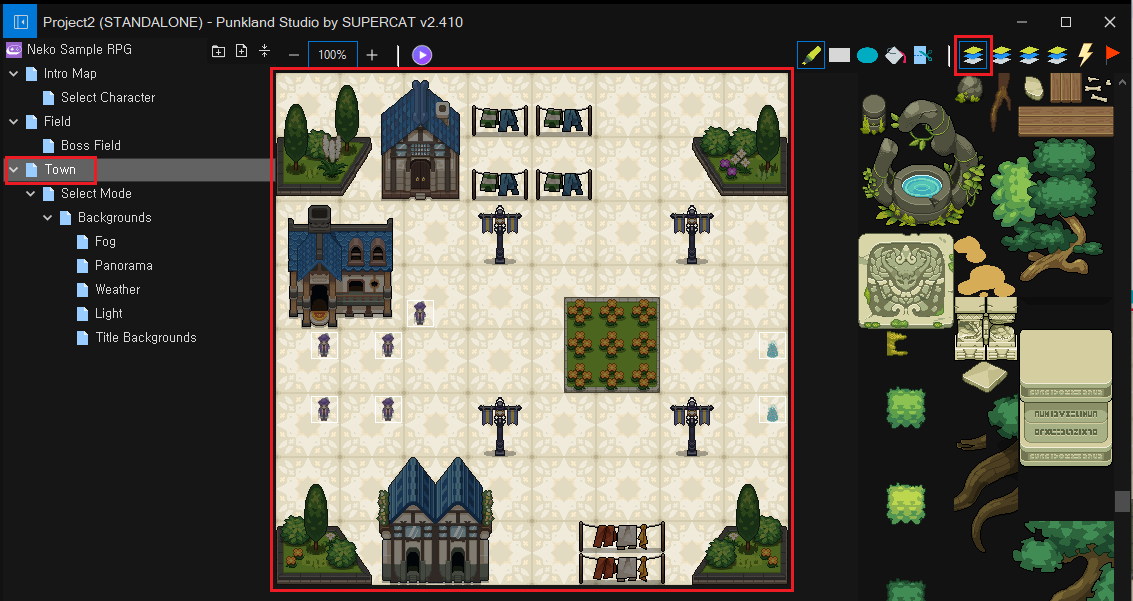
5. **\[Layer 1] / \[Layer 2] / \[Layer 3] / \[Layer 4]**: Displays or edits specific layers.
6. **\[Smart Layer]**: Automatically adjusts the layer based on tile type.
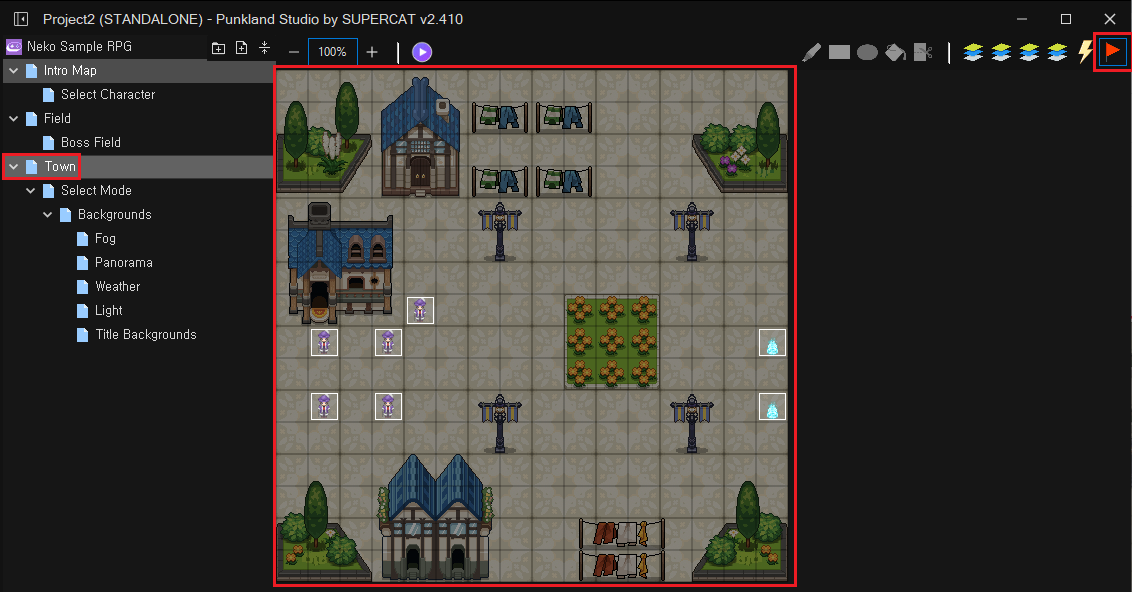
7. **\[Event Layer]**: Displays events on the map.
8. **\[1/1], \[1/2], \[1/4]**: Adjusts the zoom level of the map.
9. **\[Show Event Names]**: Displays the names of events on the map.

Refer to the screenshots below for examples of the view changes when selecting each menu item.

<figure><img src="/files/WkvAyg39SfCHrYkix0Bk" alt=""><figcaption></figcaption></figure>

**\[Show Current and Sub-Layers]**

<figure><img src="/files/1xDIDF7SVerTQmoGwk92" alt=""><figcaption></figcaption></figure>

**\[Show All Layers]**

<figure><img src="/files/Lz02cQ5FcD9O7PbayXcS" alt=""><figcaption></figcaption></figure>

\[Dim Non-Current Layers]

<figure><img src="/files/cg0ccTqHSc3Bho87QlGo" alt=""><figcaption></figcaption></figure>

\[Show Collision Areas]

<figure><img src="/files/AKK0lQO0h9TUfwut4n13" alt=""><figcaption></figcaption></figure>

\[Layer 1] / \[Layer 2] / \[Layer 3] / \[Layer 4]

<figure><img src="/files/xHzXr3QPWYcM6emUcBpc" alt=""><figcaption></figcaption></figure>

\[Layer 1]

<figure><img src="/files/hh2frbFRYqls9WHLAcB4" alt=""><figcaption></figcaption></figure>

\[Layer 2]

<figure><img src="/files/EnMFFEnTWQ8Lxpq3wpgz" alt=""><figcaption></figcaption></figure>

\[Layer 3]

<figure><img src="/files/joBJULfuErhr2lbI7HKf" alt=""><figcaption></figcaption></figure>

\[Layer 4]

<figure><img src="/files/qzvxebkRxHALCMCwJWji" alt=""><figcaption></figcaption></figure>

\[Smart Layer]

<figure><img src="/files/9fXFatrpYT23YCIl60Dp" alt=""><figcaption></figcaption></figure>

\[Event Layer]

<figure><img src="/files/HUsjQgwrzRl6kLXM2Glz" alt=""><figcaption></figcaption></figure>

\[1/1]

<figure><img src="/files/GWd5FVqYRoCiU3QiWfUN" alt=""><figcaption></figcaption></figure>

\[1/2]

<figure><img src="/files/TJKZ3Ql7liSrOwcTR1ZU" alt=""><figcaption></figcaption></figure>

\[1/4]

<figure><img src="/files/60SiIfkrw3K0MN2DwKTC" alt=""><figcaption></figcaption></figure>

\[Show Event Names]

<figure><img src="/files/1M9dAEeYY2vsjIT1SfnL" alt=""><figcaption></figcaption></figure>


---

# Agent Instructions: Querying This Documentation

If you need additional information that is not directly available in this page, you can query the documentation dynamically by asking a question.

Perform an HTTP GET request on the current page URL with the `ask` query parameter:

```
GET https://docs.punkland.io/punkland-studio/studio/studio-interface/view-tab.md?ask=<question>
```

The question should be specific, self-contained, and written in natural language.
The response will contain a direct answer to the question and relevant excerpts and sources from the documentation.

Use this mechanism when the answer is not explicitly present in the current page, you need clarification or additional context, or you want to retrieve related documentation sections.